

Helicopter > Kamov Ka-52
Description Kamov Ka-52 "Alligator"
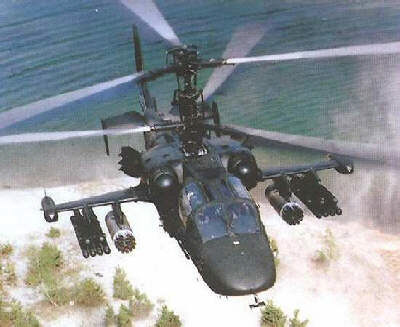
The Original
Even one of the newest Soviet attack helicopters, the Hokum (meaning Alligator), features the typical Kamov trademark: the superimposed, counter-rotating rotors (coaxial rotors), which eliminate the need for a tail rotor. The Alligator is the two-seat version of the Kamov 50 Hokum attack helicopter (codename Werwolf), which was developed for the Soviet armed forces over a period of 10 years. Characteristic of the Ka-52 is the new cockpit, which has two side-by-side seats. The front of the fuselage was completely redesigned to accommodate the extensive electronic equipment, radar, and advanced night vision devices required to control the modern weapon systems. The Hokum is powered by two Klimov turboshaft engines mounted at the wing roots of its high-wing stub wings. The pilot and weapon systems operator sit side by side.
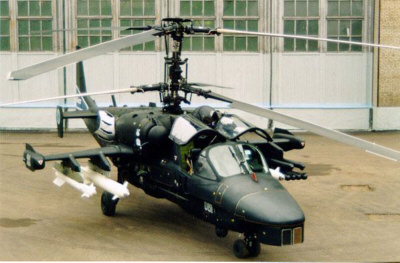
Technology
The coaxial arrangement of the two rotors results in high maneuverability for the helicopter. The absence of a tail rotor also allows for a higher payload than conventional helicopters, since a standard main/tail rotor configuration requires approximately 15% of the engine power for the tail rotor. With the coaxial rotor, this power can be almost entirely used for lift and thrust.
This fast and agile helicopter features exceptionally robust armor plating for the cockpit and other vital components. Safety features include jettisonable rotor blades and ejection seats for emergencies.
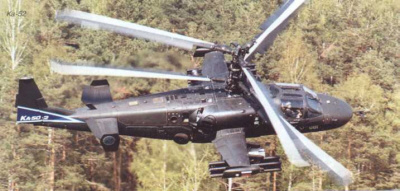
Armament
A 30 mm 2A42 cannon with 280 rounds is mounted in the right side of the fuselage; its barrel can traverse vertically by up to 30° and laterally by 5-6°. The four underwing hardpoints typically carry twelve laser-guided ATGW Wichr missiles or (in four B-8 tube launchers) a total of 80 unguided C-8 air-to-surface missiles. Various other armaments are also possible.
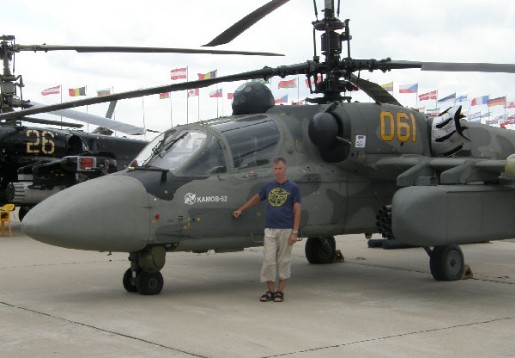
Future
While production numbers for the single-seat Ka-50 remain low, Kamov unveiled the prototype of the new two-seat Ka-52 attack helicopter in September 1996. It differs from the Ka-50 primarily in its new forward fuselage with side-by-side seating for the pilot and weapons systems officer. Since almost 85% of the design could be adopted from the Ka-50, production preparation costs were significantly reduced. According to Kamov, the Ka-52 is not a night-fighting version of the Ka-50, but rather is intended to complement it when deployed. Its main tasks are all-weather reconnaissance, target designation, and the command and control of a helicopter attack squadron. A special data bridge is installed for cooperation with ground troops.
Reproduction only with the author's permission. All information is provided without guarantee.